The Cognitive Neuroscience of Risk and Gambling Behaviour
A multidimensional approach to understanding Gambling Harms
The multi-dimensional nature of gambling harms


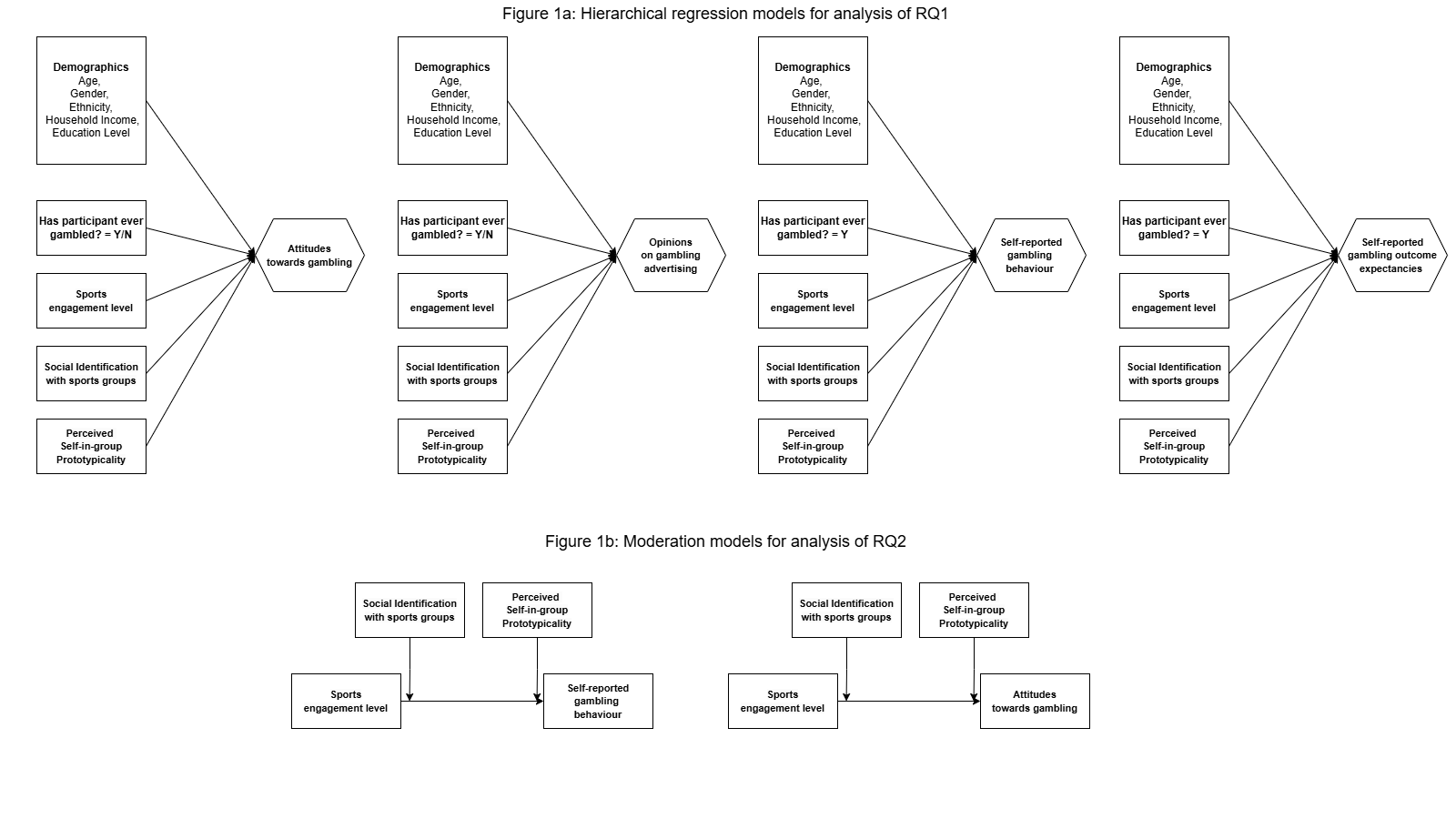
Focus: “It’s part of the sport” project
Dr Christopher Wilson, Dr Srdan Medimorec, Prof. Judith Eberhardt, Dr. Robert Portman, Hannah Poulter, Lorraine Temple
Project Team

Project Structure

Work Package 1
References
Atte Oksanen, Atte Oksanen, Anu Sirola, Anu Sirola, Ilkka Savolainen, Iina Savolainen, Aki Koivula, et al. 2021. “Social Ecological Model of Problem Gambling: A Cross-National Survey Study of Young People in the United States, South Korea, Spain, and Finland.” International Journal of Environmental Research and Public Health 18 (6): 3220. https://doi.org/10.3390/ijerph18063220.
Borrell, Jennifer, and Jacques Boulet. 2005. “A Critical Exploration of Objectivity and Bias in Gambling (and Other) Research.” International Journal of Mental Health & Addiction 2.
Bowden-Jones, Henrietta, Roxanne W. Hook, Jon E. Grant, Konstantinos Ioannidis, Ornella Corazza, Naomi A. Fineberg, Bryan F. Singer, et al. 2022. “Gambling Disorder in the UK: Key Research Priorities and the Urgent Need for Independent Research Funding.” The Lancet Psychiatry 9 (4): 321–29. https://doi.org/10.1016/S2215-0366(21)00356-4.
Constandt, Bram, Johan Rosiers, Jolien Moernaut, Stef Van Der Hoeven, and Annick Willem. 2022. “Part of the Game? Exploring the Prevalence and Normalization of Gambling in Belgian Sports Clubs.” International Journal of Environmental Research and Public Health 19 (11): 6527. https://doi.org/10.3390/ijerph19116527.
Duggan, Brendan, and Gretta Mohan. 2022. “A Longitudinal Examination of Young People’s Gambling Behaviours and Participation in Team Sports.” Journal of Gambling Studies 39 (2): 541–57. https://doi.org/10.1007/s10899-022-10175-x.
Gale, Nicola K., Gemma Heath, Elaine Cameron, Sabina Rashid, and Sabi Redwood. 2013. “Using the Framework Method for the Analysis of Qualitative Data in Multi-Disciplinary Health Research.” BMC Medical Research Methodology 13 (1): 117. https://doi.org/10.1186/1471-2288-13-117.
Jetten, Jolanda, S. Alexander Haslam, Tegan Cruwys, Katharine H. Greenaway, Catherine Haslam, and Niklas K. Steffens. 2017. “Advancing the Social Identity Approach to Health and Well-Being: Progressing the Social Cure Research Agenda.” European Journal of Social Psychology 47 (7): 789–802. https://doi.org/10.1002/ejsp.2333.
Lopez-Gonzalez, Hibai, Mark D. Griffiths, and Susana Jimenez-Murcia. 2021. “The Symbolic Construction of Sports Betting Products.” International Gambling Studies 21 (3): 498–515. https://doi.org/10.1080/14459795.2021.1937274.
Marko, Sarah, Samantha L. Thomas, Kim Robinson, and Mike Daube. 2022. “Gamblers’ Perceptions of Responsibility for Gambling Harm: A Critical Qualitative Inquiry.” BMC Public Health 22 (1): 725. https://doi.org/10.1186/s12889-022-13109-9.
Raimo, Simona, Maria Cropano, Luigi Trojano, and Gabriella Santangelo. 2021. “The neural basis of gambling disorder: An activation likelihood estimation meta-analysis.” Neuroscience and Biobehavioral Reviews 120 (January): 279–302. https://doi.org/10.1016/j.neubiorev.2020.11.027.
Reith, Gerda, and Fiona Dobbie. 2011. “Beginning Gambling: The Role of Social Networks and Environment.” Addiction Research & Theory 19 (6): 483–93. https://doi.org/10.3109/16066359.2011.558955.
Schwebel, Frank J., J. Richard Korecki, and Katie Witkiewitz. 2020. “Addictive Behavior Change and Mindfulness-Based Interventions: Current Research and Future Directions.” Current Addiction Reports 7 (2): 117–24. https://doi.org/10.1007/s40429-020-00302-2.
Seel, C. J., M. Jones, D. R. Christensen, R. May, A. E. Hoon, and S. Dymond. 2024. “Treatment of Harmful Gambling: A Scoping Review of United Kingdom-Based Intervention Research.” BMC Psychiatry 24 (1). https://doi.org/10.1186/s12888-024-05843-8.
Wilson, Christopher J. 2026. “Neurological and Behavioural Correlates of Construal in Economic Decision-Making Under Cognitive Load.” Behavioural Brain Research 496 (January): 115829. https://doi.org/10.1016/j.bbr.2025.115829.

Social Context
Funded Project: “It’s part of the sport”: Exploring how social identification with sports groups predicts gambling behaviour and how people experience the normalisation of gambling with sports groups.
Study: Sports Engagement & Implicit Associations. Testing if high sports engagement predicts a stronger implicit cognitive association between “Sport” and “Gambling.” Thomas Wilkinson
Review: Systematic Review on the efficacy of gambling harms policy-related interventions. w/ Dr. Andrew Richardson